 Gobekli Tepe Turkey Tours
Göbekli Tepe: The Site
Göbekli Tepe is a Neolithic hill site in Şanlıurfa Province in southeastern Turkey, built from about 9500 BCE by communities who had not yet made pottery. UNESCO listed it in 2018 as one of the first manifestations of human-made monumental architecture. This page explains what the site is, where it sits, what the enclosures and their T-shaped pillars show, the temple-versus-village debate, and what a visit actually looks like from the walkway under the roof. For ticket prices, opening hours, how old the site really is and the sister site Karahan Tepe, follow the dedicated pages linked throughout. If you would rather see it with a guide, the Göbekli Tepe tours compared on this site cover day trips from Istanbul by plane and day tours from Şanlıurfa.
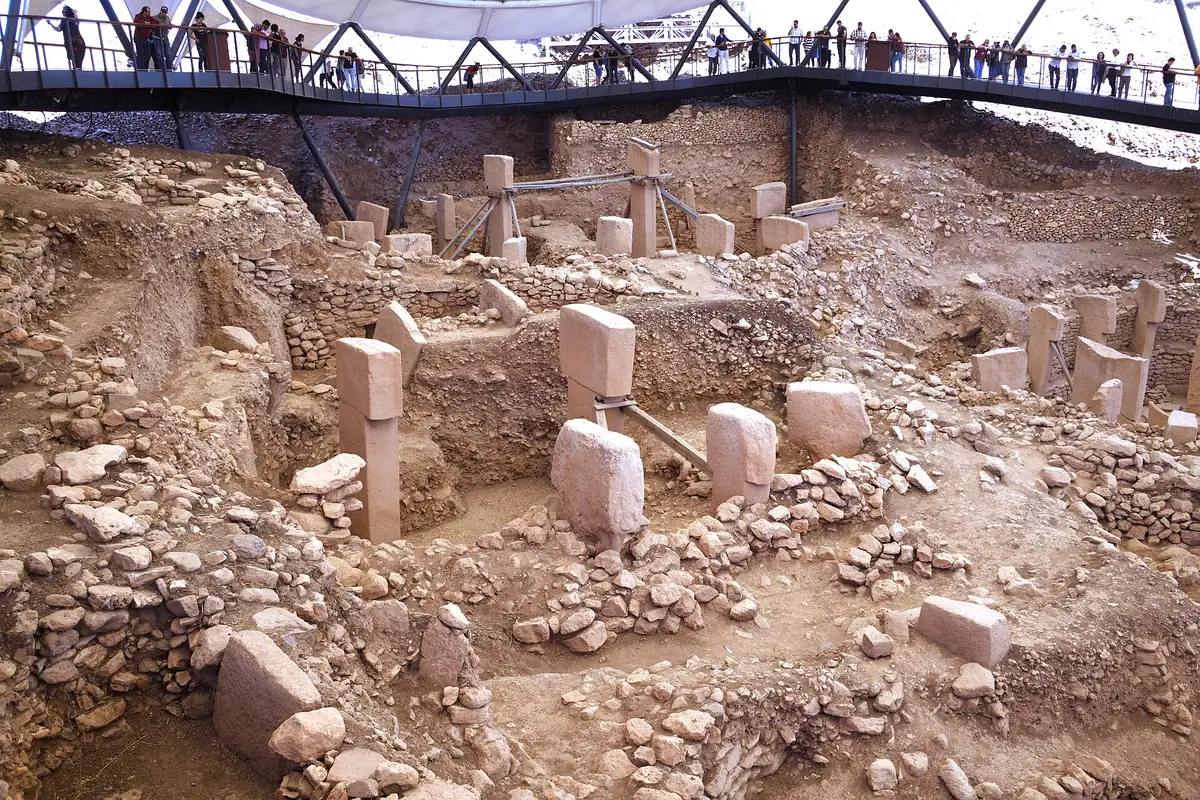
Visitors on the walkway above one of the excavated enclosures. Photo: Dosseman, CC BY-SA 4.0, via Wikimedia Commons
Quick answer Göbekli Tepe in brief
Göbekli Tepe is a Pre-Pottery Neolithic hill site near Örencik village in Şanlıurfa Province, Turkey, built from about 9500 BCE and abandoned around 8000 BCE. Its circular enclosures hold T-shaped limestone pillars up to about 5 to 6 metres tall, carved with animals and abstract symbols. UNESCO inscribed it on the World Heritage List in 2018 as one of the first manifestations of human-made monumental architecture. Only roughly 5 to 10 percent of the mound has been excavated, and visitors view the dig from a roofed wooden walkway.
Key takeaways
- Compare every day trip from Istanbul by plane on the homepage, including the Göbekli Tepe Day Trip by Plane at $915.37 per person with return flights and entry tickets in the price.
- Already in Şanlıurfa? The Göbekli Tepe Private Tour from Şanlıurfa costs $449 per person for 8 hours with entrance fees and lunch included.
- For exact entry prices, opening hours and the Museum Pass, see Göbekli Tepe tickets.
- Want the full chronology? How old is Göbekli Tepe covers the radiocarbon dates in depth.
What Göbekli Tepe Is
The basics a visitor needs: a hill, a location, a size and an age.
A Hill in the Stone Hills
Göbekli Tepe is an artificial mound, or tell, about 15 metres high and covering 8 hectares, which is about 20 acres. It stands near the village of Örencik in Şanlıurfa Province, in the Taş Tepeler, the Stone Hills, at the foothills of the Taurus Mountains. Sources disagree on the drive from Şanlıurfa city: Wikipedia's Şanlıurfa article says about 12 km northeast, My Turkey Adventure and Nomadic Niko say about 15 km, and CNN Türk and the Ministry's 2023 press release say 18 km. Plan on roughly 15 to 18 km, a 20 to 30 minute drive. Şanlıurfa GAP Airport (GNY) is further out, with Flypgs putting the airport about 36 km from the site.
The enclosures lie more than 10 metres below the highest parts of the settlement, which is why the excavation sits in a deepened pit under a protective roof. The site belongs to the Pre-Pottery Neolithic, the period from about 9600 to 7000 BCE when communities farmed, hunted and built in stone but had not yet invented pottery. Wikipedia dates the Göbekli Tepe settlement to about 9500 BCE, when it was built, and about 8000 BCE, when it was abandoned. In plain terms, the earliest structures here are roughly 11,500 years old, about 7,000 years older than the Great Pyramid of Giza, which was built around 2600 BC. The deep-dive on the dates lives at how old is Göbekli Tepe.
From a 1963 Survey to the Dig Today
The hill was first noted in a 1963 survey directed by Halet Çambel of Istanbul University and Robert John Braidwood of the University of Chicago. That survey recovered over 3,000 Neolithic stone tools. Peter Benedict, who worked on the survey material, recognised the tools as Aceramic Neolithic but mistook the exposed tops of the T-shaped pillars for grave markers, and a National Geographic account says a 1960s University of Chicago survey dismissed the hill as of little interest.
In October 1994 the German archaeologist Klaus Schmidt re-examined the location after landowner Mahmut Yıldız guided him there, and excavations began in 1995. The Ministry of Culture and Tourism has supervised the excavation since 1995. Schmidt led the dig until his death in 2014 at age 60. After that, work continued jointly under Istanbul University, the Şanlıurfa Museum and the German Archaeological Institute, with Necmi Karul of Istanbul University as overall director and Lee Clare coordinating the DAI research. Karul, not Schmidt, leads the excavation today, and he also directs the wider Taş Tepeler project. Across the site's use, over 7,000 grinding stones have been found. About 10 percent of the site had been excavated as of 2021 per Wikipedia, while Nomadic Niko and Sailing Stone Travel put it nearer 5 percent, so a fair summary is roughly 5 to 10 percent.
Sources: Wikipedia, Taş Tepeler, National Geographic
The Enclosures and Their Pillars
What stands in the ground, enclosure by enclosure, and what the pillars represent.
The Excavated Enclosures
Four large circular enclosures have been excavated so far, with diameters of 10 to 30 metres (33 to 98 feet). Geophysical surveys indicate at least 20 large enclosures in total, including 16 more still underground, each with up to eight pillars, which points to nearly 200 pillars overall. Flypgs frames the same picture as six structures found and possibly 20.
The figures below pull together what travel sources report for each enclosure, because the excavation team itself publishes no consolidated visitor count. Where the two travel writers disagree, both figures are given. A second excavation area, GT2, sits northwest of the main one and was being prepared for visitors with additional carved pillars under a green roof, per bianet and CNN Türk.
| Enclosure | What stands there | Source |
|---|---|---|
| Enclosure A | A circle reported as 12 x 13 m by one writer and 12 x 14 m by another | Sailing Stone Travel / Nomadic Niko |
| Enclosure B | About 12 m across, 11 pillars per one count, nine small pillars so far per another | Sailing Stone Travel / Nomadic Niko |
| Enclosure C | About 25 m across, nine in-situ T-shaped pillars counted by Nomadic Niko | Sailing Stone Travel / Nomadic Niko |
| Enclosure D | About 20 m across, at least 12 smaller pillars plus the two central figures, home of Pillar 43, the Vulture Stone | Nomadic Niko / Wikipedia |
| Enclosure F | Smallest reported, 7.5 m across with eight pillars | Nomadic Niko / Sailing Stone Travel |
| Lion Pillar Building | A later rectangular room with T-pillars up to 1.5 m (about 5 ft) tall | Wikipedia |
T-shaped Pillars as Stylised People
The pillars are the signature of the site. Each circle has two taller pillars facing each other at the centre, and the two in Enclosure D clearly represent humans: they have arms carved down the sides, a belt and a cloth covering the genitals. The T shape itself reads as a stylised head on a body. Sailing Stone Travel gives the Enclosure D central pillars as about 5.5 m tall and weighing over 15 tons, while Nomadic Niko puts the tallest pillars at up to 5 m. CNN Türk and Flypgs, writing about the newer excavation area, describe T-shaped pillars of 3 to 6 m and an estimated 40 to 60 tons. The weight range is disputed between sources, so think of them as monoliths up to about 5 to 6 m tall weighing tens of tons. Pillar slabs were quarried from bedrock pits about 100 m from the hilltop, and experiments suggest that 12 to 24 people could have built the later structures in under four months.
The carvings deserve their own page: lions, bulls, boars, foxes, gazelle, donkeys, snakes, arthropods and birds, especially vultures, plus abstract H-shaped symbols, crescents and disks. Only one certain female representation exists at the site, a naked woman on a slab. The most famous carving, the so-called Vulture Stone with its vultures and headless man, is covered at Göbekli Tepe Pillar 43.
Sources: Wikipedia, Sailing Stone Travel, Nomadic Niko, CNN Türk
Göbekli Tepe: The Place That Rewrote History
An archaeology channel on what the site is and what it is not. Third-party video by Miniminuteman. This site did not shoot it and has no relationship with the creator.
Temple or Village: What It Was
What the excavators think the place was for, and how that has changed.
Schmidt's Ritual Centre and the 2019 Turn
Klaus Schmidt read the site as a ritual centre used by periodically gathering nomadic bands, a sanctuary rather than a village. Popular media ran with that and called it the world's first temple. The picture has shifted. Findings published around 2019, per Wikipedia, suggest a settlement with domestic structures, cereal processing and a water supply: rainwater harvesting channels fed bedrock cisterns holding at least 150 cubic metres, and one cistern pit has a staircase of five steps. A 2019 PLOS ONE study analysed 7,268 grinding tools and concluded cereal processing was a significant part of subsistence, likely supporting work feasts that mobilised the building workforce. The team's current view is that ritual and domestic functions coexisted rather than the site being purely cultic. Some travel writers still repeat the no-settlement reading, Sailing Stone Travel among them, which shows the debate is not settled in popular accounts.
Three questions keep coming up. On burial: it is unknown why the pillars were buried every few decades and replaced with new rings inside the old ones, and landslides also buried Enclosure D. The intentional backfilling idea has fallen out of favour since Schmidt's death. On burials of people: three tombs were found on the eastmost hill group, and incised human cranial fragments found in 2017 are linked to a Neolithic skull cult, but the site is not a cemetery. On the stars: claims of an astronomical observatory have been largely rejected by the excavation team. Calendar and comet readings of the carvings, promoted in popular books and a Netflix series, remain fringe claims that most experts reject for lack of evidence. Treat them as media claims, not archaeology.
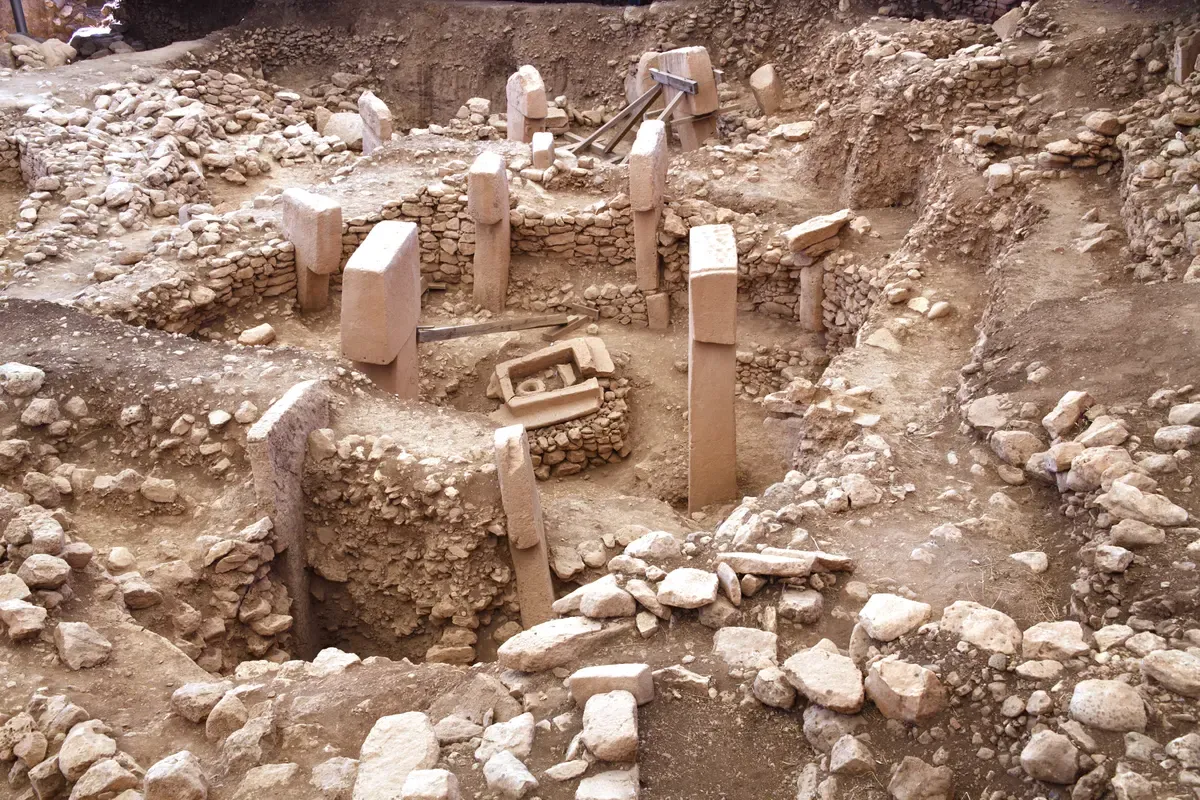
An excavated enclosure with its pillars and dry-stone walls. Photo: Dosseman, CC BY-SA 4.0, via Wikimedia Commons
What You See on a Visit
The practical shape of a visit: centre, shuttle, roof, walkway, time.
Visitor Centre, Shuttle and the Walkway
A modern visitor centre at the bottom of the hill has a ticket booth, gift shop, café and restrooms, plus an exhibition area with a short animated film, a timeline, replicas and interactive displays. A shaded tunnel runs about 200 m from the museum building to the shuttle stand. A free shuttle bus, included in the entrance price, carries visitors the last kilometre up to the hilltop, a ride of a few minutes, and walking the roughly 1 km path is also possible. From the shuttle drop-off it is about a 10 to 15 minute walk to the main canopy, per Sailing Stone Travel's account.
You do not walk among the pillars. The excavation sits under a protective roof, a fabric canopy spanning about 4,500 square metres per My Turkey Adventure, and you view the enclosures from an elevated circular walkway above the dig. The first area, GT1, is open under a white roof. A second area, GT2, just northwest, sits under a green roof and was announced with additional carved pillars and renewed walkways, so check whether it is open before you go. Travel writers put a full visit at about 90 minutes. Opening hours run 08:30 to 19:00 in summer and 08:30 to 17:00 in winter, open every day, per the Taş Tepeler project site, and current ticket prices are set out at Göbekli Tepe tickets. Getting there by bus, taxi or tour is covered at how to get to Göbekli Tepe.
Three ways to book the visit. The Göbekli Tepe and Harran Day Trip starts at $225 per person in Şanlıurfa with entrance fees included, though its Istanbul flights come only with the Full Package option. The Göbekli Tepe, Karahan Tepe and Balıklıgöl day starts at $145 per person from Şanlıurfa with lunch and fees included, but Karahan Tepe entry is not guaranteed on that listing. For both megalithic sites in one long day, the Göbekli Tepe and Karahan Tepe from Istanbul costs $900 per person with the return flights and both entrance fees in the price. The sister site is described at Karahan Tepe.
Sources: Taş Tepeler, bianet, Backpack Moments
Dos and Don'ts at Göbekli Tepe
Five things worth doing and four to avoid, all drawn from the sourced facts above.
Do
- Do take the free shuttle from the visitor centre, because it is included in the entrance price and saves the 1 km climb in the heat.
- Do start in the visitor centre exhibition, because the short film and replicas explain the enclosures before you see the real pillars from the walkway.
- Do check the season before you go, because summer hours run to 19:00 but Şanlıurfa's summer heat is severe and midday on the open plateau is the hardest time.
- Do combine the site with the Şanlıurfa Archaeology Museum in the city, because the megaliths are better understood after seeing the finds, including the original Nevalı Çori temple there.
- Do allow time for the walkway itself, because the 10 to 15 minutes from the shuttle drop-off to the canopy is only the start, and reading the carvings from above takes longer than most people plan.
Don't
- Don't expect to walk among the pillars, because visitors view the excavation from an elevated walkway under the roof and there is no access to the dig floor.
- Don't assume a tour price covers your flights, because Şanlıurfa-based tours such as the World's First Temple Tour at $495 list domestic flights as not included.
- Don't repeat the 12,000-year figure, because the sourced dating is about 9500 BCE to 8000 BCE, roughly 11,500 years, and the 12,000 figure is a media rounding.
- Don't treat Karahan Tepe entry as certain on every Şanlıurfa day tour, because at least one listing states its Karahan Tepe visit is not guaranteed.
Göbekli Tepe: Questions and Answers
What is Göbekli Tepe?
It is a Pre-Pottery Neolithic tell near Örencik in Şanlıurfa Province, about 15 metres high and 8 hectares in area, with monumental circular enclosures of carved T-shaped pillars built from about 9500 BCE. The full description is on this page's section on what Göbekli Tepe is.
What people were at Göbekli Tepe?
Hunter-gatherer communities of the Pre-Pottery Neolithic, before pottery and before settled farming villages were normal in the region. Gazelle bones suggest large-scale hunting between midsummer and autumn, which fits seasonal gatherings, and the 2019 settlement findings complicate the older nomad-only picture, as covered in the temple or village section.
Can tourists visit Göbekli Tepe?
Yes. The site is open every day, 08:30 to 19:00 in summer and 08:30 to 17:00 in winter, with a visitor centre, free shuttle and a roofed walkway over the excavation. Hours, last entry and prices are at Göbekli Tepe tickets.
Are there other sites like Göbekli Tepe?
Yes. Karahan Tepe, roughly 46 km away in the same province, belongs to the same Taş Tepeler project and shares the T-pillar tradition, with a 2023 human statue of about 2.3 to 2.45 m. The comparison is at Karahan Tepe.
Was Göbekli Tepe a temple or a village?
That is the central debate. Klaus Schmidt read it as a ritual centre, while findings published around 2019 show domestic structures, cereal processing and cisterns holding at least 150 cubic metres, and the team now sees ritual and domestic functions coexisting. The evidence is laid out in Temple or Village.
Why are the Göbekli Tepe pillars buried?
Partly by landslides, which buried Enclosure D, and partly, it seems, deliberately: the pillars were covered every few decades and new, smaller rings built inside the old ones, for reasons that remain unknown. What that means for how much is still underground is in the enclosures section.