 Gobekli Tepe Turkey Tours
Göbekli Tepe Pillar 43 and the Vulture Stone Carvings
Göbekli Tepe Pillar 43, called the Vulture Stone, is a carved pillar in Enclosure D. This page covers what is actually carved on it, where it stands, the animals and symbols across the site, the human pillars and statues, and where you can see the originals. It also gives the calendar and comet claims and the responses from the excavation side, so you can weigh them yourself. For the site's age and layout, see Göbekli Tepe and how old Göbekli Tepe is. The bookable trips are compared on Göbekli Tepe tours.
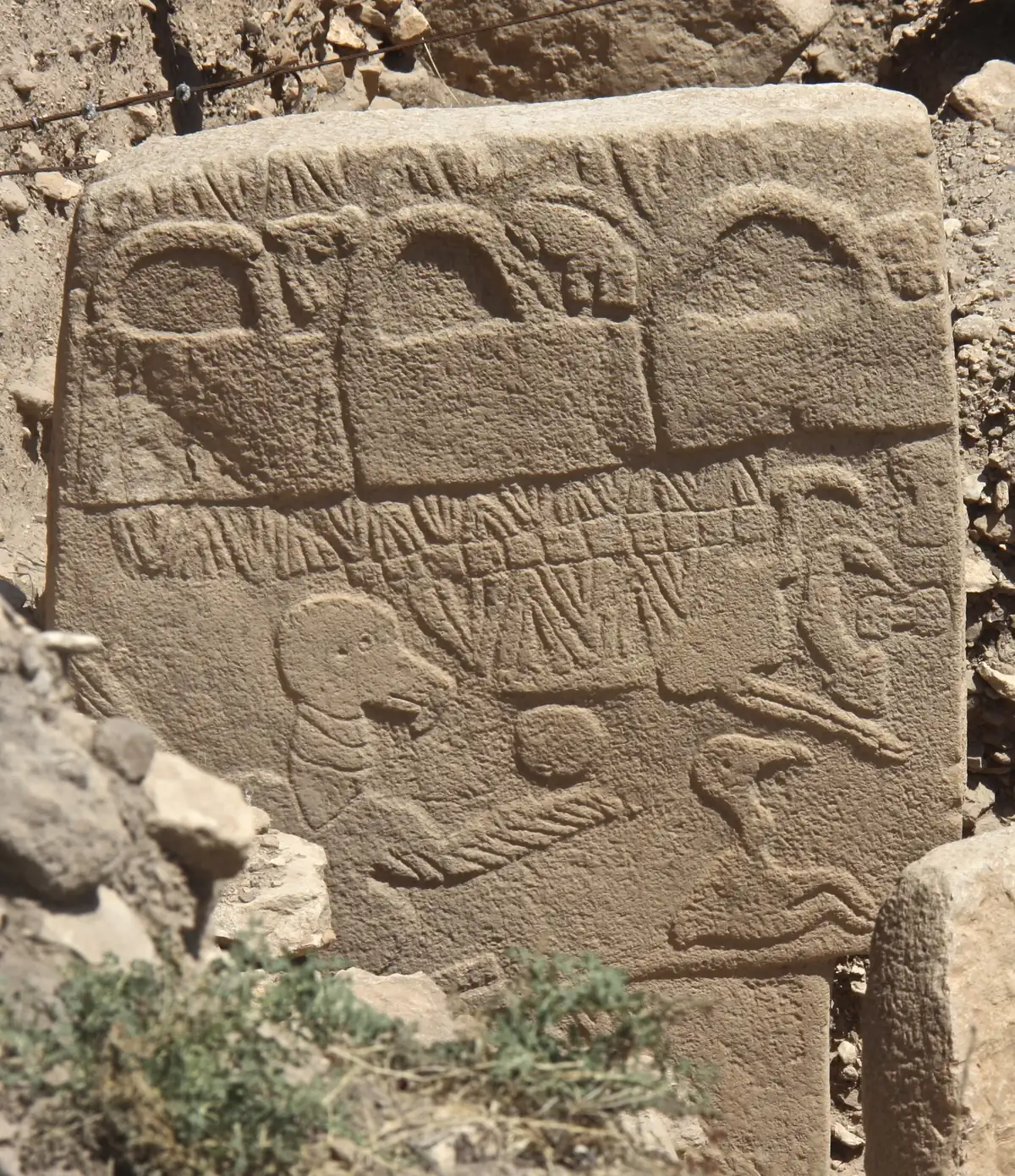
Pillar 43, the Vulture Stone, in Enclosure D. Photo: Sue Fleckney, CC BY-SA 2.0, via Wikimedia Commons
Quick answer Pillar 43 in brief
Göbekli Tepe's Pillar 43, the Vulture Stone, stands in Enclosure D and is carved with a vulture holding an orb or egg, a scorpion, a headless man with an erect phallus, birds and abstract symbols. Archaeologists read it as part of the enclosure's symbolic programme. Martin Sweatman reads it as a star map and a 365 day calendar, and his earlier claims have been disputed by the archaeologists excavating on site.
Key takeaways
- See the full carving tour plan on the homepage, including what you see at the site and tours from Şanlıurfa.
- The Göbekli Tepe Private Tour from Şanlıurfa ($449, 8 hours) covers the site and the Şanlıurfa Archaeological Museum where more carvings are displayed.
- Compare the day trips from Istanbul by plane if you want the carvings in one long day.
Pillar 43, the Vulture Stone
This pillar is the centre of the calendar and comet claims made about Göbekli Tepe.
What Is Carved on Pillar 43
Pillar 43 stands in Enclosure D at Göbekli Tepe and is known as the Vulture Stone. Wikipedia describes it as carved with vultures and a headless man with an erect phallus. The World History Encyclopedia caption adds detail: a vulture on the left holds an orb or egg in one outstretched wing, with a scorpion lower down on the stone. Around these main figures the pillar carries smaller birds and abstract signs.
The stone is a relief on a T-shaped pillar of the kind that fills the site, where pillars reach up to about 5 to 6 m and weigh tens of tons depending on the source. Enclosure D is one of four circles excavated so far, in structures with diameters of 10 to 30 m (33 to 98 ft). Its central pillars, per Sailing Stone Travel, stand about 5.5 m tall and weigh over 15 tons.
How Archaeologists Read It
Klaus Schmidt, who led the dig from 1995 until his death in 2014, saw the whole site as a ritual centre used by nomadic bands that gathered periodically. The reliefs also record the animals of the landscape: zooarchaeology shows gazelle were seasonally present, and Wikipedia links likely feasts to peak game.
Claims that the enclosure was an astronomical observatory have been largely rejected by the excavation team, per Wikipedia. So the cautious reading is this: Pillar 43 is a richly carved cult pillar whose exact message we do not know, and the strongest grounded facts are the animals and the human figure carved on it.
The Calendar and Comet Claims
In 2017, Martin Sweatman and Tsikritsis published in Mediterranean Archaeology and Archaeometry a reading of Pillar 43 as a star map and proposed a date of 10950 BCE ± 250 years. ScienceAlert notes that Sweatman's earlier findings have been disputed by the archaeologists excavating on site.
Sweatman continued with a 2024 paper in Time and Mind. It argues each V-shaped symbol is one day, giving a 365 day solar calendar of 12 lunar months plus 11 extra days, that a pillar shows the Taurid meteor stream lasting 27 days, and that it dates a comet impact to 10,850 BCE, nearly 13,000 years ago. The paper also notes Enclosure D's oldest radiocarbon date as 9530 BCE and suggests the site's origin could be closer to the Younger Dryas onset, around 10,800 BCE.
The wider Younger Dryas impact hypothesis is called fringe in Wikipedia's article on it. That article dates the proposed impact to c. 12,900 years before present and says most experts reject it for lack of clear impact evidence. Graham Hancock argued in Magicians of the Gods that the comet was linked to the Noahide flood myth, and his 2022 Netflix series Ancient Apocalypse included an episode on it. Skeptic.com summarizes Hancock's central claim, that Göbekli Tepe is too advanced for hunter-gatherers and must involve a lost civilisation, as having no hard evidence per critics. Treat the calendar and comet readings as claims, not as findings.
Sources: Wikipedia, World History Encyclopedia, ScienceAlert, Sci.News
The Animals on the Pillars
The pillars carry a bestiary of the animals that lived around Şanlıurfa when the site was built.
Species and Symbols
Wikipedia lists the carved animals as lions, bulls, boars, foxes, gazelle and donkeys among mammals, plus reptiles and snakes, arthropods and birds, particularly vultures. A second list adds mouflon, onagers and ducks. Alongside the animals come abstract symbols: H-shaped signs, crescents and disks. Only one certain female representation exists at the site, a naked woman on a slab.
Some pillars are known by a single animal. Pillar 10 in Enclosure B depicts a fox. Pillar 12 in Enclosure C shows ducks and a boar. Pillar 27 in Enclosure C shows a predator, perhaps a felid, hunting a boar. The table below gathers these named examples. Counts of pillars per enclosure differ between sources, so treat any pillar total you read elsewhere with care.
Named Animal Carvings
The named examples come from Wikipedia's site article and the World History Encyclopedia caption for the Vulture Stone. Use the table as a checklist for your visit.
| Animal | Where | Source |
|---|---|---|
| Vultures, a scorpion, a headless man | Pillar 43, Enclosure D | Wikipedia, World History Encyclopedia |
| Fox | Pillar 10, Enclosure B | Wikipedia |
| Ducks and a boar | Pillar 12, Enclosure C | Wikipedia |
| Predator, perhaps a felid, hunting a boar | Pillar 27, Enclosure C | Wikipedia |
| Snakes, boars, gazelle, mouflon, onagers, ducks | Across the site | Wikipedia |
| H-shaped symbols, crescents and disks | Across the site | Wikipedia |
The Painted Boar
A Ministry release of October 2023 described a life-size limestone wild boar found in Structure D at Göbekli Tepe with red, white and black pigment residues, called the first painted life-size example found from its period. The boar sat on a bench bearing an H-shaped symbol, a crescent, two snakes and three human faces or masks. Wikipedia's Taş Tepeler article dates the boar to 8700 to 8200 BCE.
It suggests some of the stonework was once colored.
Sources: Wikipedia, Ministry press release
Arms, Belts and Statues
The biggest pillars are not abstract columns. They are carved as people, and the museum holds the statues to prove it.
The Human Pillars of Enclosure D
Each circle at Göbekli Tepe has two taller pillars facing each other at the centre. Those in Enclosure D represent humans: Wikipedia describes arms, a belt and a cloth covering the genitals. The central pillars of Enclosure D stand about 5.5 m tall and weigh over 15 tons according to Sailing Stone Travel, though CNN Türk and Flypgs give T-shaped pillars up to 6 m tall and 40 to 60 tons in weight, so weights differ between sources.
The slab pillars were quarried from bedrock pits about 100 m (330 ft) from the hilltop. Geophysical surveys indicate 16 more enclosures beyond the four excavated, each with up to eight pillars, for nearly 200 pillars and at least 20 large enclosures in total. Experiments suggest 12 to 24 people could have built the PPNB structures in under four months.
Urfa Man and the Statues
The Şanlıurfa Archaeology Museum holds Urfa Man, a sandstone statue dated around 9000 BC and called the oldest naturalistic life-sized sculpture of a human. It sits with hands clasped over the genitals, has obsidian eye inlays and a V-shaped collar, and was found in 1993 during construction on Yeni Yol street in Balıklıgöl. Wikipedia's pages differ on its height, giving about 1.80 m on one and about 1.90 m on another.
The museum also holds Göbekli Tepe steles and a totem, plus finds from Karahan Tepe and Harran. An early PPNB totem pole stands 192 cm tall with a 30 cm diameter, with snakes carved on either side. Karahan Tepe's municipal page lists three notable works in the museum: a human statue carrying a leopard, a double-fox obelisk and a seated human statue.
Skull Fragments and Human Remains
Human remains do exist at Göbekli Tepe. Three tombs were found on the eastmost hill group, and incised human cranial fragments found in 2017 are interpreted as evidence of a Neolithic skull cult, per Wikipedia.
Sources: Wikipedia, Urfa Man, Sailing Stone Travel
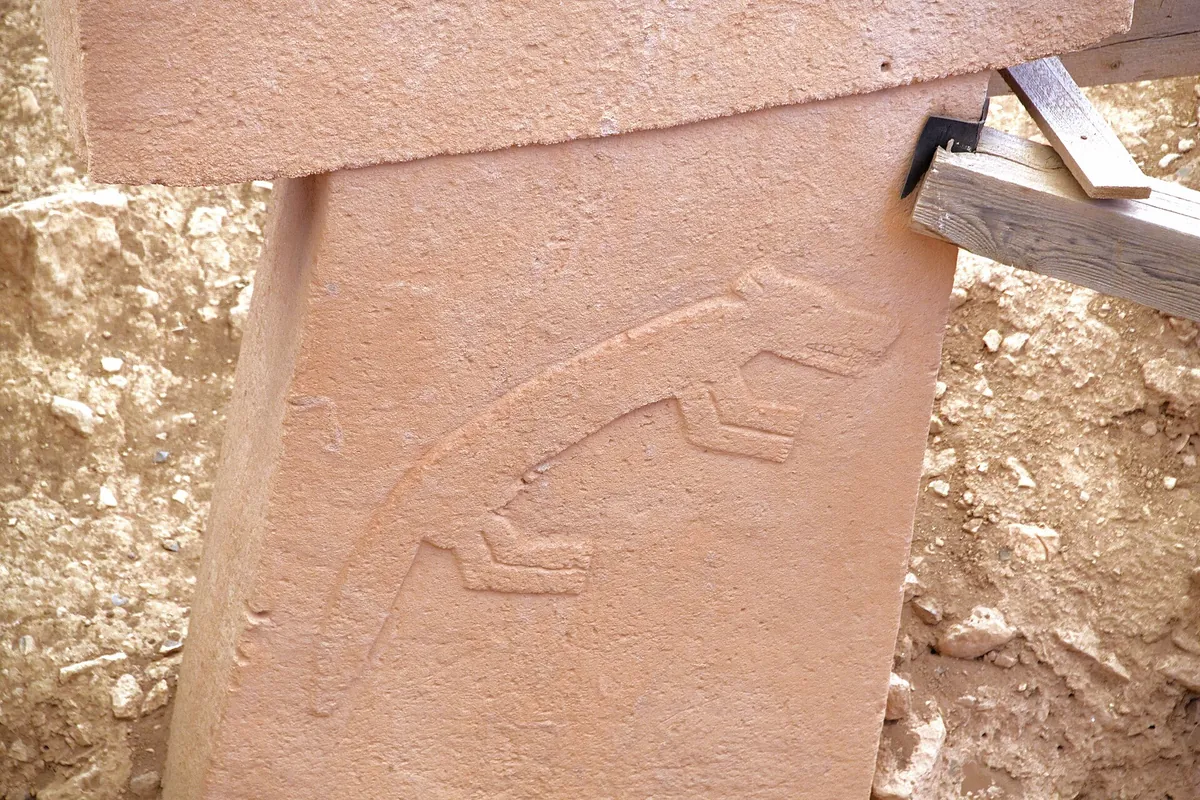
A leaping animal carved on a pillar in Enclosure B. Photo: Dosseman, CC BY-SA 4.0, via Wikimedia Commons
Where to See the Carvings
Two places cover the carvings: the tell itself and the museum in Şanlıurfa city.
At the Site: Walkway and Shelter
Visitors walk a raised route through the excavated enclosures under a protective shelter, viewing the pillars including Enclosure D from the visitor path. The site lies about 15 to 18 km northeast of Şanlıurfa's centre, with sources giving 12 to 24 km, and the drive takes 20 to 30 minutes. The Taş Tepeler page gives 08:30 to 19:00 in summer with the ticket office closing at 18:30, and 08:30 to 17:00 in winter with the ticket office closing at 16:30, open every day. Other sources give different times, so check before you go. Foreign visitors pay a euro tariff of about 20 to 22 EUR per sources that conflict, with an official joint tariff of EUR 22 applying only from 1 April, so check Göbekli Tepe tickets for the current setup.
Pillar 43 stands inside Enclosure D on the visitor route. A guided option removes the guessing: the Göbekli Tepe Private Tour from Şanlıurfa ($449 per person, 8 hours) includes entrance fees and the museum.
Şanlıurfa Archaeology Museum
The current Şanlıurfa Archaeology and Mosaic Museum opened in 2015 on Haleplibahçe Street, replacing the 1969 museum on Çamlık Street. The Ministry leaflet says about 10,000 artefacts are exhibited and the building has a 4.5 km long promenade route, the longest in Turkey. The complex covers 200,000 m² per Hürriyet Daily News. You can see Urfa Man, the Göbekli Tepe steles and totem, and an imitation of Enclosure D, the leaflet's 'D Temple', alongside the original Nevalı Çori Temple.
Several tours build the museum in. The Göbekli Tepe, Harran and Museum Tour ($174, 8 to 9 hours) starts at the museum or your hotel, though its listing names museum tickets and does not name Göbekli Tepe admission. The Göbekli Tepe and Karahan Tepe Private Day ($1,300, 13 to 17 hours, from Istanbul with flights) names admission to Göbekli Tepe and the Archaeology Museum. For a full picture of what a day costs, see what a tour costs and the site ticket on Göbekli Tepe tours.
Sources: Ministry leaflet, Taş Tepeler
Questions About Pillar 43 and the Carvings
What is the meaning of Pillar 43 at Göbekli Tepe?
No agreed meaning exists. Schmidt read the site as a ritual centre for nomadic bands that gathered periodically, and claims of an astronomical observatory have been largely rejected by the excavation team. Sweatman's earlier star-map claims have been disputed by archaeologists excavating on site. The safest summary is a carved cult pillar whose message is unknown, as covered in the Vulture Stone section.
What is carved on the Vulture Stone?
A vulture holding an orb or egg in one outstretched wing, a scorpion lower down, a headless man with an erect phallus, and smaller birds and abstract signs, per the World History Encyclopedia caption and Wikipedia. See the full list in Pillar 43, the Vulture Stone.
Have any human remains been found at Göbekli Tepe?
Yes. Three tombs were found on the eastmost hill group, and incised human cranial fragments found in 2017 are linked to a Neolithic skull cult, per Wikipedia. The skull fragments are described under skull fragments and human remains.
What is the controversy with Göbekli Tepe?
The main controversy is the comet and lost civilisation claim. Graham Hancock argued the site records a comet impact and needs an advanced precursor culture, which critics at Skeptic.com say has no hard evidence, and Wikipedia's Younger Dryas article calls the impact idea fringe. Sweatman's 2024 calendar paper claims a 365 day solar calendar, and ScienceAlert reports his earlier findings have been disputed by archaeologists excavating on site. Both sides are laid out in the calendar and comet claims.
Can visitors see Pillar 43 at the site?
Pillar 43 stands in Enclosure D, and visitors view the excavated enclosures from the raised walkway under the shelter, so you see the pillar as part of the circuit. The Göbekli Tepe Private Tour from Şanlıurfa ($449, 8 hours) covers the site with entrance fees included.
Where can I see the Göbekli Tepe statues and original carvings?
The Şanlıurfa Archaeology Museum holds Urfa Man, dated around 9000 BC, the Göbekli Tepe steles and totem, and Karahan Tepe statues including a human figure carrying a leopard. The museum opened in 2015 on Haleplibahçe Street and exhibits about 10,000 artefacts, per the Ministry leaflet. Details are in Where to See the Carvings.