 Gobekli Tepe Turkey Tours
Şanlıurfa (Urfa): The City Beside Göbekli Tepe
Şanlıurfa, which most people simply call Urfa, is the city most travelers use as a base for Göbekli Tepe. This guide covers what the city itself offers: the sacred fish pool at Balıklıgöl, the cave where Abraham is believed to have been born, the castle above the old town, the covered bazaar and the Şanlıurfa Archaeology Museum with the Urfa Man statue. It also covers food, dress at the holy sites, the climate and how many days to set aside. For the stones themselves see the guide to Göbekli Tepe tours, for sleeping options see hotels near Göbekli Tepe, and for the journey in see how to get to Göbekli Tepe. The bookable trips are compared on Göbekli Tepe tours compared.
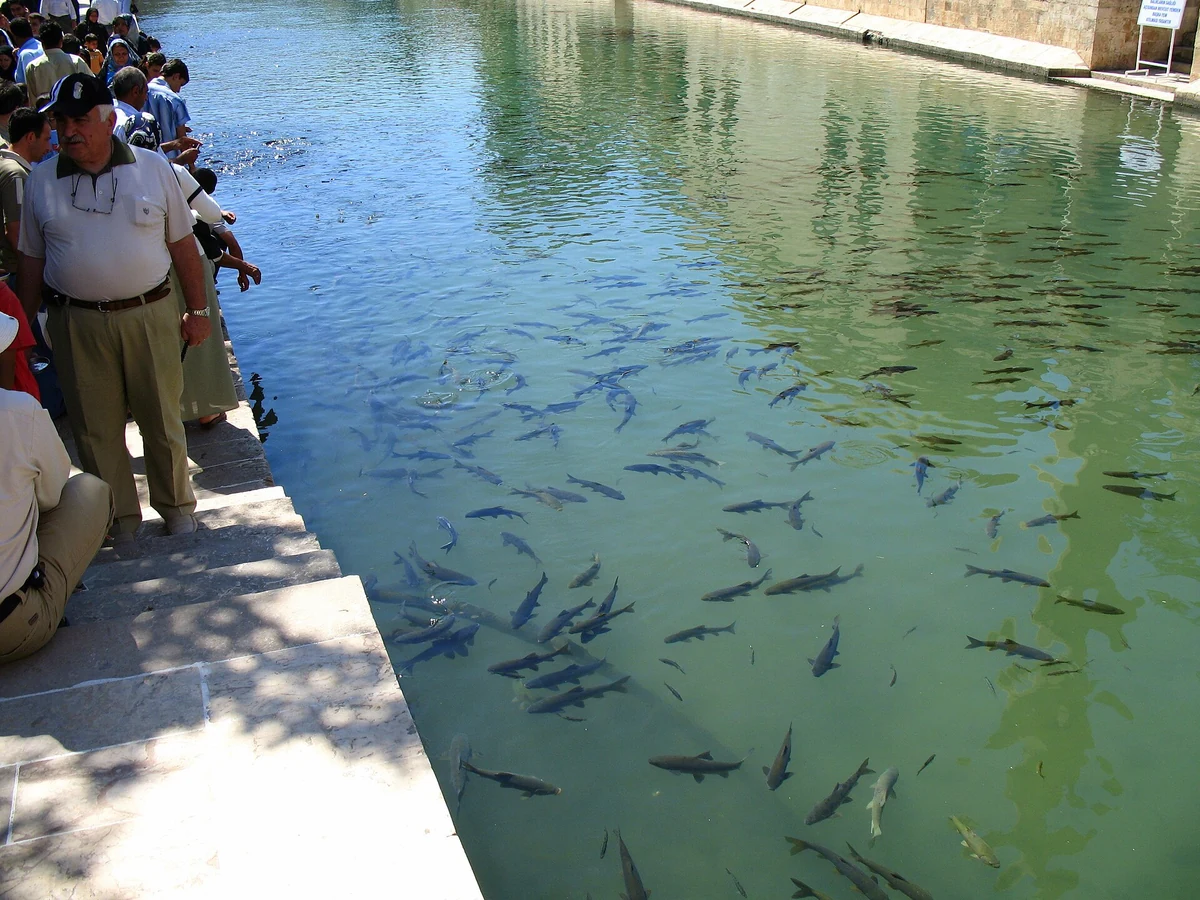
The sacred carp of Balıklıgöl. Photo: Nilstycho, CC BY 2.5, via Wikimedia Commons
Quick answer Şanlıurfa at a glance
Şanlıurfa is a city of 596,637 people (2022, Wikipedia) at 477 m elevation in southeastern Turkey, about 15-18 km from Göbekli Tepe. It is the base for the neolithic sites and a destination in its own right. Most sights sit in a walkable old town core around the holy fish pool.
Key takeaways
- Balıklıgöl, the birth cave, the castle and the bazaar cluster within walking distance of each other, and the Göbekli Tepe Private Tour from Şanlıurfa starts in Şanlıurfa itself.
- Compare every departure in one place on the homepage under tours from Şanlıurfa, or read how Göbekli Tepe tours are priced and what each package includes.
Urfa in Brief
A provincial capital of half a million people with a very old name and a very old core.
Where It Is and How Big
Şanlıurfa sits at 477 m (1,565 ft) elevation on the dry plains of southeastern Turkey. Wikipedia gives the urban population as 596,637 for 2022. The city is the natural base for Göbekli Tepe, which lies about 15-18 km from the centre, roughly 20-30 minutes by car. Karahan Tepe is about 46 km away according to Hürriyet Daily News. Şanlıurfa GAP Airport (GNY) is in the Karaköprü district, which Wikipedia describes as the city's third urban district.
The city received a new trolleybus line that opened on 28 April 2023, a 7.1 km route numbered 63 running from Emirgan Aktarma Merkezi.
Adma, Edessa, Urfa, Şanlıurfa
The city has carried many names. Wikipedia records the earliest as Admaʾ (also written Adme, Admi, Admum) in Old Assyrian sources. Seleucus I Nicator renamed it Edessa around 303 BC after the Macedonian city, and a later Seleucid-era name was Callirrhoe. Syriac speakers called it Urhay or Orhay, Kurds call it Riha, and Arabic sources used ar-Ruha and Urha before the short form Urfa settled in.
The modern prefix came in 1984, when the Turkish National Assembly added 'Şanlı' (glorious) to reward the city's resistance to British and French troops after World War I. The Ottoman tax register of 1518 counted 1,082 families, a little over 5,500 people, and by 1566 the estimate had grown to 13,000 to 14,000.
Because of the Edessa connection, tour operators bill the old town as Edessa, as the Göbekli Tepe and Harran Day Trip does in its list of stops.
The 2023 Earthquakes and Floods
On 6 February 2023 two large earthquakes, Mw 7.8 at 04:17 and Mw 7.7 at 13:24 local time, struck southeastern Turkey, with 53,537 deaths across the country. For Şanlıurfa province the death toll is disputed: Wikipedia lists 340, while Urfanatik reports official data of 180 deaths and 20 fully collapsed buildings, with 20,596 independent units at medium or heavy damage.
A month later, on 15 March 2023, floods killed 21 people in the region, 17 of them in Şanlıurfa and four in Adıyaman, per Wikipedia's flood list. The Copernicus flood service reports that the Şanlıurfa Archaeology Museum and the Haleplibahçe Mosaic Museum flooded, though they had not been damaged by the earthquakes.
The neolithic sites came through unharmed. Turkey's Culture Ministry stated that Göbekli Tepe suffered no damage, and UNESCO said it did not appear damaged.
Sources: Wikipedia: Şanlıurfa, Wikipedia: 2023 Turkey-Syria earthquakes, Urfanatik
What to See in Şanlıurfa
Six sights, all within the old town core or a short ride away.
Balıklıgöl
Old town centreThe Pool of Abraham is the heart of the city. Legend says Nimrod cast Abraham into a fire, God turned the flames into this pool and the logs into the carp, which local belief holds sacred, so no one may catch or eat them. The Halil ür-Rahman Mosque with its minaret of 1211-12 stands on the south side, the Rızvaniye Mosque on the other, and south of the main pool lies Ayn Zeliha, shaded by trees and ringed with cafés.
Mevlid-i Halil Cave
Free · no hour restrictionsLegend places Abraham's birth in this cave just south of the Halil ür-Rahman Mosque, on Balıklı Göl Cd. No:51. Showcaves lists entry as free with no opening-hour restrictions, headscarves provided at the entrance, and separate entrances for men and women. The cave is hot inside with little ventilation, and the passage is low enough that you stoop.
Urfa Castle
Daylight · 10-minute climbTwo columns on the hill above the pool are the only remnant of an Abgarid winter palace from the 3rd century, and the current walls date to the Abbasids in 814 AD. Turkeytravelplanner says the climb to the fortress takes 10 minutes and gives the best panorama of Urfa. Turkeytravelplanner also covers the site alongside the rest of the old town.
Kapalı Çarşı, the covered bazaar
South end of Divan CaddesiThe maze-like covered bazaar sits at the south end of Divan Caddesi, a short walk from Balıklıgöl, cool in summer and warm in winter. In its middle stands Gümrük Hanı, a two-story caravanserai around a roughly square courtyard, dated by different sources to the late 16th, 18th or 19th century. The Urfa Bedesten was built in 1562 and restored in 1998, and the İsotçular Çarşısı is named for the homemade chili peppers sold there.
Şanlıurfa Archaeology Museum
08:30 open · closed hours vary by sourceThe current complex opened in 2015 on Haleplibahçe Street, replacing the 1969 museum on Çamlık Street, and holds about 10,000 artefacts across four exhibition halls. Its star is the Urfa Man, a sandstone statue dated c. 9000 BC, about 1.8 to 1.9 m tall, found in 1993. Hours differ by source: the Ministry leaflet gives 08:30 to 18:30 in summer and 08:30 to 17:00 in winter, while Taş Tepeler's page prints 08:30 to 19:00 in summer with the ticket office closing at 18:30, so confirm on the day. See it on the Göbekli Tepe, Harran and Museum Tour.
Haleplibahçe Mosaic Museum
Same complex · one ticketThe mosaic museum is the southern building of the same Haleplibahçe complex near Balıklıgöl. Hürriyet Daily News reports the mosaics cover 1,500 m² and show hunting and war scenes featuring Amazon queens, dated to the 5th and 6th centuries A.D. by a Hürriyet piece. The Orpheus mosaic of 184 A.D., found in Edessa in 1980 and returned from the Dallas Museum of Art in 2015, is here, and a blog summary says one museum ticket admits both buildings, with MüzeKart valid.
Food, Dress and Timing
What to eat, how to dress at the holy sites, and how long to stay.
What Urfa Eats
Daily Sabah lists isot (Urfa pepper), çiğ köfte, Birecik eggplant and licorice sherbet among the registered local foods. Wikipedia's legend says çiğ köfte was first made by Abraham from ingredients at hand, and Chasing the Donkey notes that today's version is made with fine bulgur wheat, not raw meat. Other dishes named by sources are ciğer kebabı (liver kebab), the famous Urfa kebab, eggplant kebab, lahmacun and borani, with şıllık, a walnut-stuffed crepe, as a dessert.
Food here is savory and pretty spicy, per Chasing the Donkey, and asking for 'acısız' means not spicy. For an evening out, Elite World describes sıra gecesi as nights in open-air and indoor venues with regional music and regional dishes. Only some tours feed you: the Göbekli Tepe Private Tour from Şanlıurfa includes lunch, while others leave meals to you, so check each listing.
Dress at the Holy Sites
Chasing the Donkey calls Şanlıurfa a conservative city and advises dressing modestly and removing shoes at mosques. At the Mevlid-i Halil Cave, Showcaves says headscarves are provided at the entrance and men and women use separate entrances. Turkish Travel Blog's writer borrowed a headscarf for a small donation, used the women's entrance in the side of the courtyard, removed shoes inside and found a low passage requiring a stoop.
Shoulders and knees covered is the practical reading of these sources, and no fetched source states a stricter rule, so no stricter rule is claimed here.
The Climate and the Best Months
Şanlıurfa has a hot-summer Mediterranean climate (Köppen Csa) with 2,746.5 hours of mean annual sunshine. Wikipedia's 1991-2020 normals give mean daily maxima of 10.6 °C in January and 39.5 °C in July, with a record high of 46.8 °C. In a July heatwave, nearby Ceylanpınar recorded 47.7 °C, while Silopi recorded Turkey's highest ever at 50.5 °C. The record low is -12.4 °C, set long ago in 1932, and annual precipitation is 450.5 mm.
The practical window is spring and autumn. Chasing the Donkey gives April to June temperatures of 15 to 25 °C and September at 20 to 30 °C, against summer highs up to 40 °C, and My Turkey Adventure recommends spring (March to May) and autumn (September to November) for the sites.
How Many Days
Chasing the Donkey recommends at least three days in Şanlıurfa, with two days giving an overview. That leaves a day for the old town sights and the museum, a day for Göbekli Tepe, and a third for Karahan Tepe or an out-of-town site. Harran and its beehive houses lie outside the city and fill another day, covered in the Harran guide.
If you would rather not arrange the days yourself, the comparison of Göbekli Tepe tours on the homepage sorts departures by length and price.
Sources: Daily Sabah, Chasing the Donkey, Wikipedia: Şanlıurfa
The Non-touristy Side of Türkiye: Şanlıurfa
A walk through the old town, the pools and the bazaar. Third-party video by Bery Istanbul Tips. This site did not shoot it and has no relationship with the creator.
Day Tours from Şanlıurfa
Four day tours start in Şanlıurfa itself, so no flights are involved and you sleep in your own hotel. The table lists the catalog prices per person from each tour card, the length, and the main stops, so you can see at a glance which sites each package covers. Entry rules differ between them and are stated below the table, and none of these four prices covers a flight.
Comparing the Four Departures
The cheapest, Göbekli Tepe, Karahan Tepe and Balıklıgöl, starts at $145 per person and includes entrance fees, lunch and drinks, but its listing says the Karahan Tepe entry is not guaranteed. The Göbekli Tepe World's First Temple Tour at $495 runs 8 hours with dinner and water included, adds Harran, and ends with an airport transfer, though flights are not included and all sales are final.
The Göbekli Tepe, Harran and Museum Tour at $174 runs 8 to 9 hours with museum tickets and lunch, but Göbekli Tepe admission is not named in its includes list, so ask the operator. The private Göbekli Tepe Private Tour from Şanlıurfa at $449 includes entrance fees, lunch and bottled water over 8 hours for 1 to 4 adults.
| Tour | Price | Stops |
|---|---|---|
| Göbekli Tepe Private Tour from Şanlıurfa | $449 per person | Göbeklitepe, Archaeology Museum, Balıklıgöl, Abraham's Cave, Edessa necropolis |
| Göbekli Tepe World's First Temple Tour | $495 per person | Göbeklitepe, Abraham's Cave, holy fish pond, Harran |
| Göbekli Tepe, Karahan Tepe and Balıklıgöl | $145 per person | Göbeklitepe, Karahan Tepe (not guaranteed), Balıklıgöl, bazaars |
| Göbekli Tepe, Harran and Museum Tour | $174 per person | Göbeklitepe, Harran, Balıklıgöl, Archaeology Museum, Mosaic Museum, Old Bazaar |
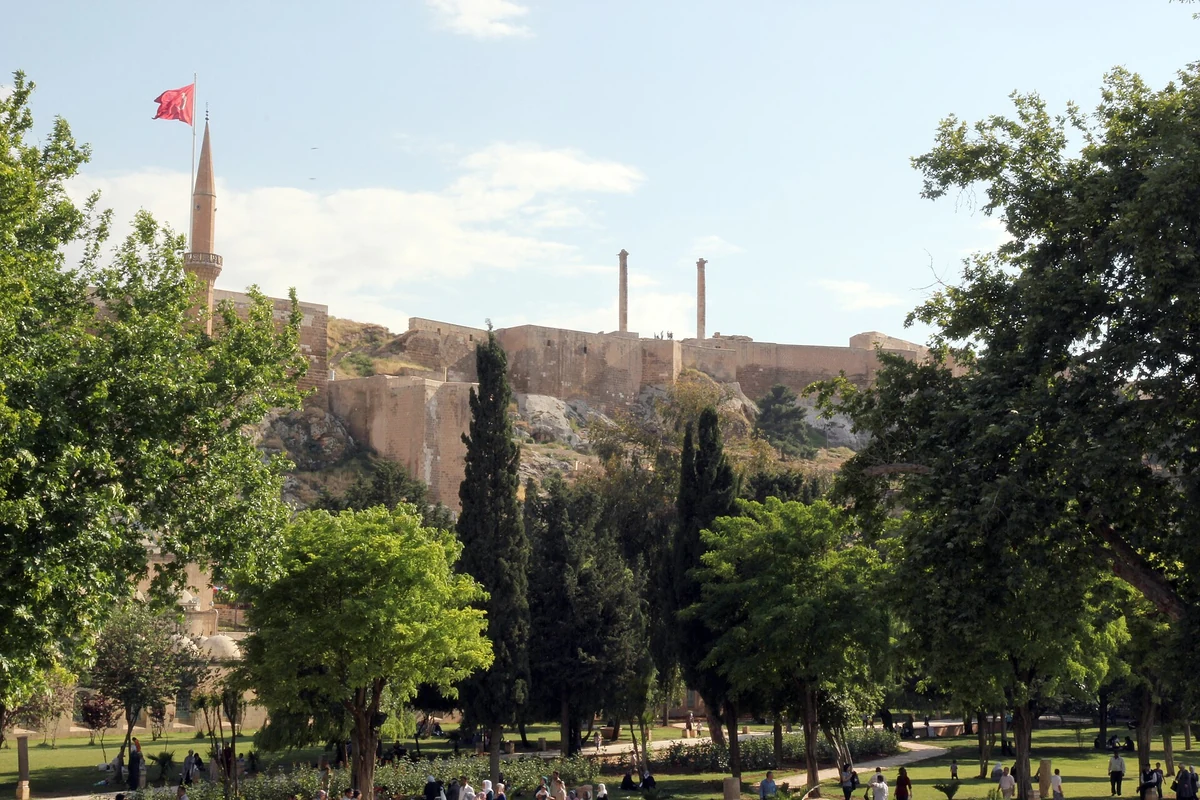
Şanlıurfa castle above the old town. Photo: Klaus-Peter Simon, CC BY-SA 3.0, via Wikimedia Commons
Do and Don't in Şanlıurfa
Five things worth doing and four to avoid, each with the reason.
Do
- Do visit the Şanlıurfa Archaeology Museum before Göbekli Tepe, because it holds the Göbekli Tepe steles, the Urfa Man dated c. 9000 BC and an imitation of the D Temple that will make the site itself make sense.
- Do carry a headscarf or plan to borrow one at the Mevlid-i Halil Cave, because Showcaves says headscarves are provided at the entrance and men and women enter separately.
- Do schedule your sightseeing for spring or autumn, because July's mean daily maximum is 39.5 °C and the record is 46.8 °C, heat that makes walking the old town hard work.
- Do plan at least two, ideally three days in the city, because Chasing the Donkey recommends three days with two as an overview, and the museum plus the old town alone fill a day.
- Do buy a single museum ticket at Haleplibahçe, because a blog summary reports the ticket admits both the archaeology museum and the mosaic museum with no extra fee, and MüzeKart is valid.
Don't
- Don't try to catch or eat the carp at Balıklıgöl, because the fish are considered sacred and people are not allowed to take them, though feeding them is encouraged.
- Don't count on a strict schedule at the museums, because the Ministry leaflet and the Taş Tepeler page print different closing times, 18:30 versus 19:00 in summer, so check on the day.
- Don't visit in midsummer if you can help it, because Chasing the Donkey records summer highs up to 40 °C and the 2025 heatwave pushed Ceylanpınar to 47.7 °C.
- Don't assume every day tour from Şanlıurfa includes the same things, because one at $145 says Karahan Tepe entry is not guaranteed and one at $174 does not name Göbekli Tepe admission in its includes list.
Where to Stay in Şanlıurfa
Each link opens the live room list for that place on the booking site, with today's prices. The old town puts you on foot from the pools and the bazaar, the museum quarter sits beside the Archaeology and Mosaic museums.
Old town by Balıklıgöl
- Suits
- On foot to the pools, the cave and the bazaar
Stone konak hotels in the lanes of the old town.
See stays in Old town by BalıklıgölHaleplibahçe and the museum
- Suits
- Beside the Archaeology and Mosaic museums
A short ride to the old town and on the road out to Göbekli Tepe.
See stays in Haleplibahçe and the museumŞanlıurfa FAQ
Where is Şanlıurfa located in Turkey?
Şanlıurfa sits on the plains of southeastern Turkey at 477 m elevation, with an urban population of 596,637 (2022, Wikipedia). Göbekli Tepe lies about 15-18 km from the centre, roughly 20-30 minutes by car. The guide on how to get to Göbekli Tepe covers the journey from Istanbul and beyond.
Is Şanlıurfa the birthplace of Abraham?
It is the site of belief, not of proof. Legend places Abraham's birth in a cave just south of the Halil ür-Rahman Mosque at Balıklıgöl, and the same legend says the pool formed when God turned Nimrod's fire into water and the logs into sacred carp.
What are the best things to do in Şanlıurfa?
The core sights are Balıklıgöl and its two mosques, the Mevlid-i Halil Cave, Urfa Castle with its 10-minute climb, the Kapalı Çarşı bazaar and the Haleplibahçe museum complex with the Urfa Man and the 1,500 m² of Amazon mosaics. Several day tours such as the Göbekli Tepe, Karahan Tepe and Balıklıgöl wrap the city sights together with the neolithic sites.
Can you eat the fish at Balıklıgöl?
No. The carp of Balıklıgöl are considered sacred, people are not allowed to catch or eat them, and visitors are encouraged to feed them instead. Local belief about Ayn Zeliha, the smaller pool south of the main one, goes further and says its water strikes blind whoever drinks it, per Wikipedia's Balıklıgöl article.
How many days should I spend in Şanlıurfa?
Chasing the Donkey recommends at least three days, with two days giving an overview. One day covers the old town and the museum, one covers Göbekli Tepe, and a third covers Karahan Tepe or Harran. If you want a guided plan, see the Göbekli Tepe 2-Day Private Tour, which runs two days from Şanlıurfa.
How far is Göbekli Tepe from Şanlıurfa?
About 15-18 km from the city centre, 20-30 minutes by car. Sources differ, with Wikipedia saying 12 km, and the Ministry's 2023 press release, CNN Türk and Flypgs 18 km, but 15-18 km is the range most guides settle on. The getting there page lists the bus and taxi options in detail.